
who's about to replace your firm?
This year's Nobel in Economics shows why strategy teams miss the warning signals

A competitor releases a product update. It’s quiet. A little sloppy. Your team notes it, flags it low-risk, and moves on.
Three quarters later, that same firm has taken a top client, hired two of your engineers, and locked in a partnership that resets pricing expectations across your segment.
It wasn’t invisible. It just didn’t look like a threat—yet.
One client’s internal tracker labeled a midsize European vendor as “non-strategic.” Six months later, that vendor was embedded in a client’s core workflow—and our client’s renewal rate dropped 12% in that segment. Nobody had logged the product updates. Everyone had seen the press release. Nobody had taken it seriously.
This year’s Nobel in Economics (Aghion & Howitt’s 1992 Schumpeterian Growth Model) helps explain why these patterns repeat. Philippe Aghion and Peter Howitt built a model of growth that doesn’t depend on stability. It depends on replacement. Their model shows innovation peaks in markets where rivals are operating at similar capability levels—what they call ‘neck-and-neck’ conditions. That’s where replacement risk moves fastest.
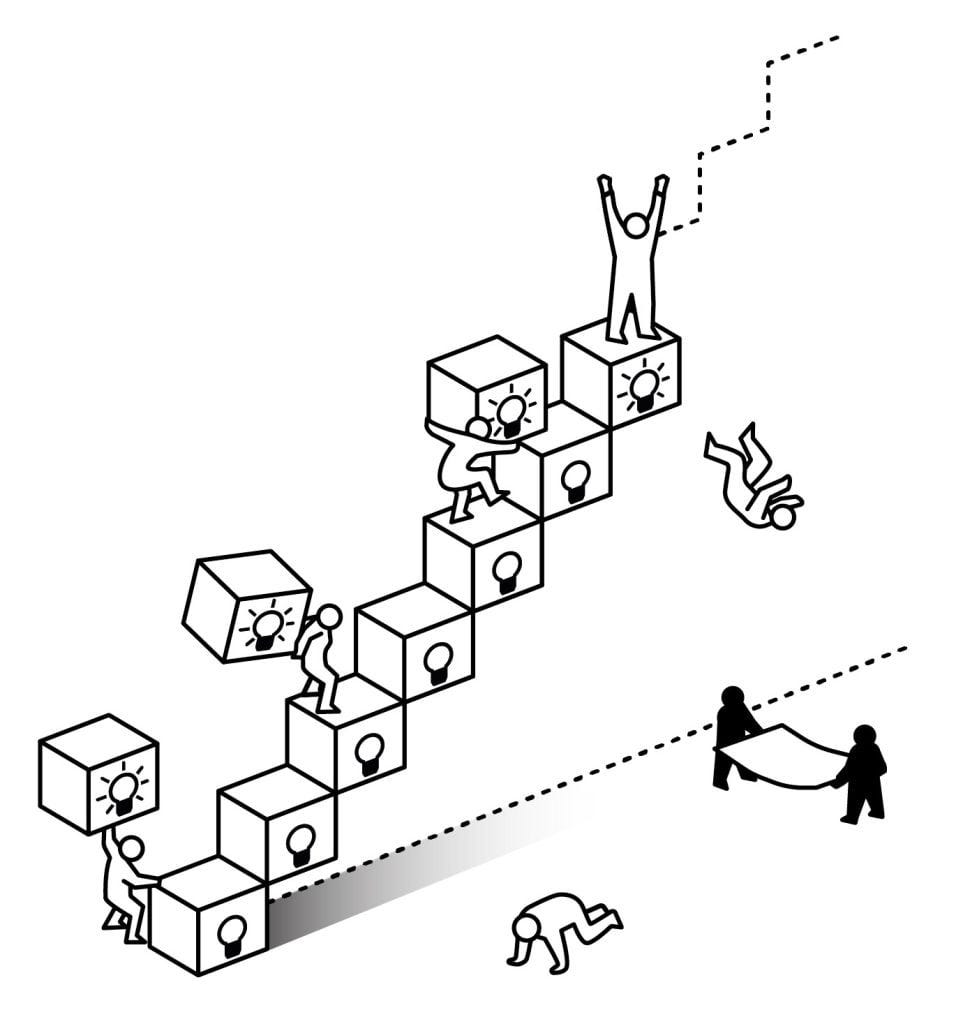
Their work on creative destruction offers a precise way to understand how innovation moves through a market: who advances, who stalls, and when the risk shifts from latent to active.
For strategy and intelligence teams, this is not academic.
The model itself is brutal in its logic: innovation doesn’t accumulate, it displaces. Growth happens when someone makes the current best option obsolete, not when everyone gets incrementally better. That shift in perspective reframes the job of a strategy team: don’t just monitor who’s improving. Track who’s trying to erase you.
The Model Behind the Pattern
Aghion and Howitt’s work formalizes a basic but often misread idea: growth doesn’t come from everyone improving at once. It comes from new entrants outperforming incumbents and making them irrelevant.
Their model shows how this process—what Schumpeter called “creative destruction”—drives long-run productivity. But more usefully, it describes the conditions under which innovation accelerates, stalls, or gets absorbed before it reaches impact.
The most important structural insight is that innovation peaks under pressure—but only the right kind. In low-competition markets, firms don’t bother. In cutthroat markets, the returns aren’t worth the risk. But in “neck-and-neck” conditions—when firms are close in technical capability—R&D spending surges. The Aghion-Howitt model formalizes that sweet spot. It shows exactly when firms invest, when they stall, and when one jump in quality triggers a cascade of exits.
These “neck-and-neck” conditions are where R&D intensity rises, product cycles compress, and new category leaders emerge. The firms behind them often don’t look dominant at first. But they behave differently. They recruit differently. They ship faster. They take strategic risks that laggards cannot.
The model calls this the innovation frontier. Whoever gets there first wins the rents—until someone else does. There’s no second place in growth that comes from replacement.
The model also predicts that once these firms break ahead, the rest fall back quickly. Innovation slows. Disruption gets priced in. Strategy teams often misread this as stability when in fact the underlying shift has already occurred.
Understanding where your market sits on this curve is not abstract. It defines which signals matter, which threats are credible, and how long you have before the window to act closes.

What It Looks Like in the Field
The pattern plays out through product cadence, hiring patterns, and partner activity—often before revenue shifts. Strategy and intelligence teams that catch it early may be able to forecast timing.
In automotive, the shift to software-defined vehicles hasn’t just reshaped what cars can do, it’s altered the competitive set. Traditional OEMs now compete with firms that operate on tech-company cycles. Tier-1 suppliers with long-standing relationships are losing business to smaller players that build modular systems. The firms gaining ground are often the ones closest in capability to the incumbents—not the ones far ahead or behind. That’s textbook neck-and-neck behavior.
In b2b software, AI-native tools are fragmenting established categories. Startups with narrow features but fast update velocity are pulling users away from legacy platforms. The incumbents that respond with bundled acquisitions or integrations are trying to regain proximity to the new frontier. The ones that wait are watching retention decay behind the dashboard. Again, the model holds: intensity is highest where capabilities are close, and the window to compete closes fast once separation occurs.
These are not just anecdotes. They’re field evidence of a model in motion: small capability gaps widen fast, and the winner rewrites the segment baseline before the laggard adjusts.
In financial services, regulatory automation is redrawing the landscape. Fintechs that originally served compliance teams now offer transaction monitoring, risk scoring, and client onboarding pipelines. The biggest institutions haven’t been blindsided. They’ve been too slow to adjust. Procurement cycles and internal politics delay the response. Innovation doesn’t need to be better to win. It only needs to be faster through the right entry point.
Across sectors, the story is the same: the most dangerous firms are the ones you already know, but underestimate because they haven’t broken out yet. The Aghion-Howitt model gives you a way to track them without overreacting or missing the turn.
How to Adjust Your Coverage and Timing
Most intelligence teams are organized to monitor position. The firms you track are the ones with market share, brand strength, or recurring mentions in customer calls. But if growth happens through replacement, and the riskiest competitors are the ones closest in capability—not size—then coverage models need to shift.
Start by mapping where your category is on the competition–innovation curve. Are the top firms converging in quality and speed? Are smaller players catching up through talent, funding, or differentiated positioning? These are the conditions under which creative destruction accelerates. Your job is to identify where those conditions exist before performance metrics confirm them.
Build shortlists of firms operating within two product cycles of your core platform or offering. This may include startups, but also second-tier players with clear technical motion. Watch for changes in R&D hiring, capital efficiency, and new customer types. These usually shift before revenue does.
These are proxies for race position. The model shows that the most consequential races are not between giants and minnows, but between firms that can credibly knock each other out.
Expand how you track incumbents, too. When a top-three firm in your space begins acquiring instead of building, it may be buying time. A move that looks like dominance could be retreat under pressure.
Time your alerts accordingly. Not every change in the field is urgent. But when a firm in a neck-and-neck position increases velocity or gains a structural edge—distribution, integration, pricing flexibility—you don’t have three quarters to react.
The model doesn’t predict winners. It sharpens your understanding of when the conditions for replacement are forming, and what early signs actually matter. Most of what’s called “disruption” looks obvious in hindsight. Your job is to see it when it’s still deniable.
Many firms revisit these structures too late—after a loss or leadership push. I’ve seen clients get more leverage by treating innovation pressure as a persistent input, not a quarterly fire drill.
Who do you go to when you know your internal coverage is too backward-looking, but bandwidth’s too tight to fix it?
Which firm, tool, or individual is your unfair advantage in catching strategic threats early?
It’s not that you can’t see them—but because you don’t want to waste cycles on noise.
Most teams can identify their biggest competitor and their fastest mover. But ask them to name the firm that’s technically close, shipping faster, and two cycles from category relevance… and may get silence. That’s the threat profile that matters. It’s the one strategy teams are least equipped to track.
Don’t Just Forward This Article. Forward These Three Questions to Your Team:
Are our top three tracked competitors the same as last year?
Have we flagged any second-tier firm as “likely to win share” in the past 6 months?
Can we name any player with neck-and-neck R&D velocity that isn’t currently a market leader?
If the answers aren’t clear—or if they all come back “no”—your coverage isn’t tuned to replacement risk. This year’s Nobel Prize-winning model suggests you’re not set up to spot replacement risk until after it lands.
This Is Your Job Now
The theory of creative destruction isn’t new. What Aghion and Howitt did was make it legible, so you can use it.
The hard part is not spotting innovation. It’s understanding when the pace, position, and structure of the market make it consequential. Most firms don’t miss the signal. They just explain it away until the outcome is already priced in.
This year’s Nobel gives us a better way to think about innovation risk. Use it to audit your attention. If your current coverage isn’t calibrated for replacement risk, this is the signal to change it.
Aghion and Howitt gave us a map of when and why the rules of advantage flip, and how often the winners hold power for shorter than anyone expects.
The teams we work with don’t need more dashboards. They need outside eyes that don’t miss the shift while everyone inside the org is watching the top three players. We build that lens with them, and tune it to the point of risk, not noise.
The problem usually isn’t that you’re missing data. But most enterprises we evaluate overweight incumbents, over-index on revenue, and undertrack velocity proxies—because that’s what the dashboard tells them to do.
Adil Husain is the founder of The Intelligence Council and Managing Director of Emerging Strategy, a leading global competitive strategy firm. He’s spent over two decades in the trenches of global business, advising multinationals, building remote-first teams, and helping clients outmaneuver competitors across international markets.
He writes to test ideas, challenge conventional wisdom, and draw smart people into orbit.
If you want to connect, collaborate, or argue, you can reach him at adil@intelligencecouncil.com