
the mbb pricing illusion
You’re not paying for hours. But you’re not paying for outcomes either.

If you’ve hired McKinsey, Bain, BCG or next-tier firms within the last 18 months, the work didn’t come from where you think it did.
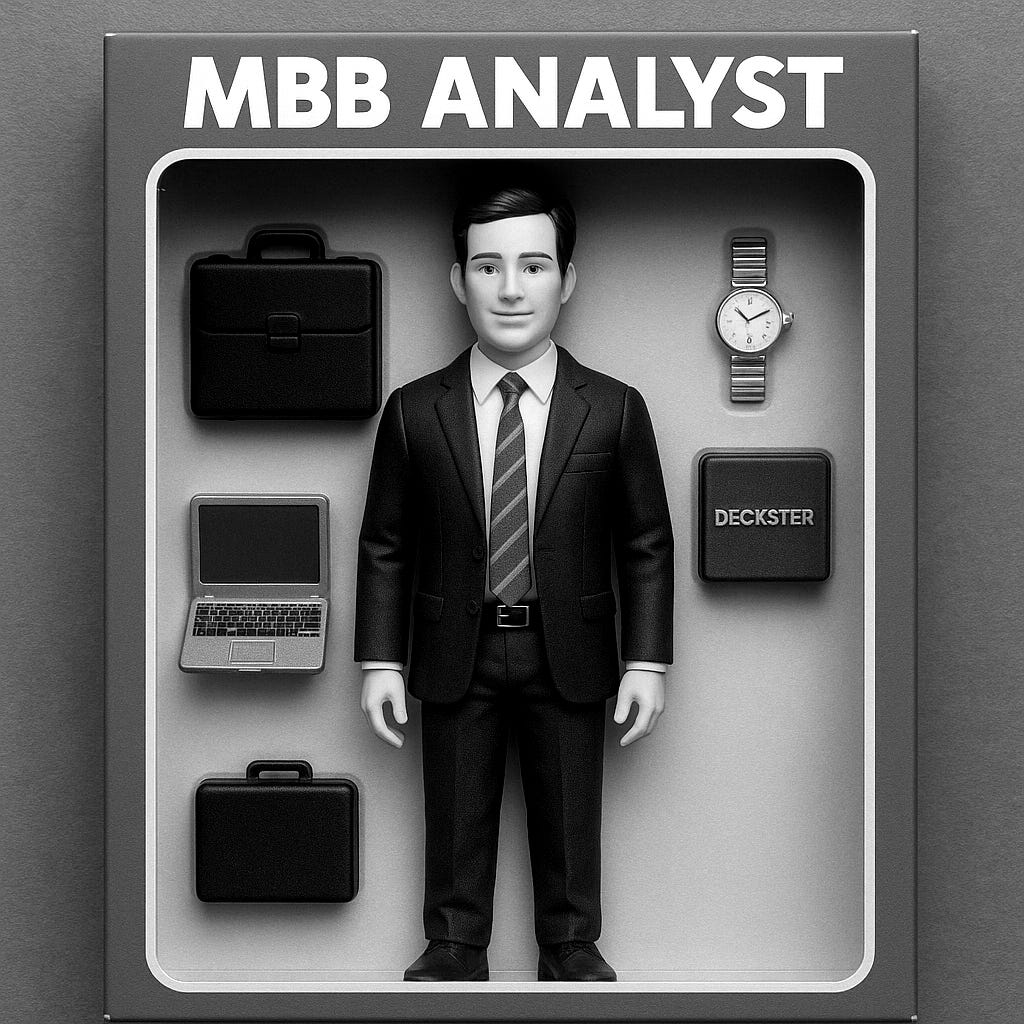
Yes, the partner may have shaped the storyline. But the proposal, research, and slide deck you saw likely came from internal AI platforms like Lilli (McKinsey), Deckster (BCG), or Sage (Bain). These systems now handle core content delivery once assigned to junior consultants, using firm-specific prompts, templates, and language models trained on decades of prior engagements.
Seventy-five percent of McKinsey staff use Lilli regularly. The platform answers over half a million prompts a month. It replaces significant analyst hours—and by extension, headcount.
And yet, clients tell us the external MBB pricing hasn’t moved.
Most enterprise clients are still paying as if none of this has changed. And the firms are happy to keep it that way.
I’m not telling you to stop hiring consultants—it’s how I make a living. But if you’re going to pay 4x premium fees, you should at least know what you’re paying for.
The Old Story: Time, Talent, Trust
For decades, the premium pricing of strategy work rested on a simple logic: elite firms staffed engagements with top-tier talent, working long hours to produce custom insights for complex decisions.
The bill was large because the labor was expensive.
Clients weren’t just buying output. They were underwriting the presence of “the best and brightest” focused on their business. Time and talent were the justification. Brand trust was the multiplier.
But that model no longer maps to how the work is actually done.
The hours are no longer being spent.
The “talent” increasingly sits at the interface between prompt and template. And the trust? It now covers a production model the client isn’t invited to examine.
The New Justification: “We Price for Value”
Ask an MBB partner today why the fee is what it is, and you won’t hear about man-hours. You’ll hear about value.
It’s a shift in language, not in economics. Internally, these firms still track utilization, staffing leverage, and margins the way they always have. But externally, they’ve moved the conversation away from effort and toward outcomes—without taking on any of the outcome risk.
If the work no longer reflects time spent—and never reflected results delivered—what exactly is it anchored to?
You can’t say the fee is based on value while remaining structurally allergic to performance-based pricing. You can’t continue to charge based on outdated staffing models while getting AI to do much of the heavy lifting.
Value-based pricing, in this context, mostly just means higher margins, because the underlying cost model has quietly collapsed.
What Strategy Firms Have Actually Become
MBB and their cousins no longer run on talent and time. They run on infrastructure.
Decks, proposals, research summaries—these are now generated through internal systems trained on prior deliverables and fed programmatic uploads of fresh market data. The result is repeatable, scalable, and on-brand. It’s also largely unexamined by clients, who still believe they’re buying bespoke work created by Harvard and Wharton graduates.
What they’re really buying is a production engine with prestige.
And that engine is getting more efficient every quarter.
But unless you're negotiating from a position of awareness, the gains flow one way: back to the firm.
Are You Training Their Model?
If your firm has worked with MBB in the past five years, there’s a non-zero chance that your project data—research, synthesis, even deliverables—helped train the very tools now used to serve your competitors.
Most client contracts grant ownership of work product to the client. But as firms build internal AI platforms on top of prior engagements, the boundaries blur. The insights you paid to generate may now be abstracted, anonymized, and piped into firmwide infrastructure.
They’ll say it improves quality. And maybe it does.
But the net effect is clear: you fund the learning loop. They retain the knowledge. And they sell the pattern recognition at full price—over and over again—to you and to others.
If you’re not auditing how your data is retained and reused by Lilli, Deckster, and Sage, you may be subsidizing your rivals’ strategy decks.
Because if you don’t change how you buy strategy consulting, the firms have no reason to change how they sell it.
What Strategic Buyers Should Actually Be Demanding
This isn’t about pushing for discounts. It’s about aligning pricing with reality.
If the core delivery model has shifted from labor-intensive to infrastructure-enabled, then buyers should stop pretending they’re paying for hours, or overlooking the fact that they’re also not paying for outcomes.
The smarter move isn’t to haggle over fees. It’s to redefine what the fee is for.
Not staffing
Not scope
Not surface polish
Instead:
Judgment
Speed
Relevance
Consequence
If the firm is charging based on value, then they should be expected to accelerate decision-making, deliver sharper insight, and embed clarity where it didn’t exist before.
Otherwise, what’s left is process theater: AI-generated decks delivered by analysts clad in SuitSupply and Allen Edmonds.
Some firms—yes, including mine—deliver strategic clarity without the legacy markup. We use technology, too. But we don’t hide behind it, and we don’t pretend process polish is value. You’re paying for insight, not ceremony. That’s the model that should win.
If the Work Has Changed, So Should the Terms
McKinsey will not voluntarily cut prices. Bain won’t walk in and offer risk-sharing. BCG will not itemize what was produced by Deckster versus a consultant. That’s not how this works.
But strategy buyers can change the conversation.
Not by asking for less—but by expecting more.
More velocity. More precision. More direct connection between what’s delivered and what matters.
How to Buy Strategy Consulting—Starting Now
Ask what came from a partner’s original thinking—and what came from ‘Deckster.’ Not everything needs to be bespoke. But you deserve to know what you’re actually buying.
Strip away the ceremony. If you're paying a premium for branded strategic insight, stop letting them anchor pricing to team size, project scope, or engagement length.
Tie fees to consequences. You don’t need a full outcome-based contract. But you should define what good looks like—and what happens if it’s not delivered.
Build your own system memory. Don’t let your institutional knowledge get re-extracted by a new team every 18 months. Treat your past strategy work as infrastructure, not archaeology.
And if the firms can’t provide that—if they default to artifacts over insight, and polish over consequence—then maybe it’s not the pricing that needs to change.
It’s the provider.
At Emerging Strategy, we work with global enterprises that need real insight—not ceremony. We combine AI tooling with human analysts based in lower-cost, high-talent locations to deliver sharp, decision-ready intelligence. You’re not covering bloated overhead. You’re paying for clarity. And we don’t charge like it’s still 2017. If you’re ready to rethink your strategy spend, we should talk.
Adil Husain has over two decades of experience advising Fortune 1000 firms on global expansion and market strategy. Adil is a thought leader in market strategy, market intelligence and competitive intelligence and active within the strategy and intelligence professional communities. Adil is Managing Director at Emerging Strategy, a global strategic intelligence firm that helps multinational enterprises navigate complex international markets, informed by AI-enabled primary research and secondary research.
You can contact Adil here, or connect with him on LinkedIn.

broken feedback loops

Everyone’s talking about AI productivity. No one’s asking what it’s replacing.
"strategic uncertainty" isn't strategy

U.S. Treasury Secretary Scott Bessent recently attempted to lend intellectual weight to the Trump administration’s renewed tariff blitz by invoking game theory.